There is no breakfast more beloved, more nutritious or more deeply satisfying than a plate of perfectly soft idlis — white as clouds, steamed to perfection, served with coconut chutney and sambar.
Idli is not just a breakfast dish. It is a tradition. It is the most important meal in millions of South Indian households every single morning. It is one of the most searched recipes on Google India every day. And it is widely considered one of the healthiest breakfast foods in the entire world.
But achieving that perfect restaurant quality softness at home — idlis that are fluffy inside, slightly spongy, melt in your mouth — requires understanding a few key secrets.
And one of those secrets is greasing your idli moulds with pure wood pressed coconut oil.
At Waookytchen our wood pressed coconut oil is cold pressed using traditional methods — preserving its natural coconut aroma, lauric acid and medium chain triglycerides that make it the perfect oil for authentic South Indian idli making.
Here is our complete foolproof recipe for the most perfect soft idli you will ever make at home.
What is Idli?
Idli is a traditional South Indian steamed rice cake made from a fermented batter of rice and urad dal. It originated in South India — primarily Tamil Nadu, Karnataka, Andhra Pradesh and Kerala — and has become one of India’s most universally eaten breakfast foods.
It is:
- 🥞 Completely steamed — zero oil in cooking
- 🌿 Naturally gluten free
- 💪 High in protein from urad dal
- 🦠 Probiotic rich from fermentation
- ⚡ Very easy to digest
- 👶 Perfect first food for babies
- 🏥 Recommended for sick people and elderly
- 🧘 Ayurveda’s ideal breakfast food
Idli has been recognised by nutritionists worldwide as one of the most perfectly balanced breakfast foods — combining carbohydrates from rice, protein from dal and probiotics from fermentation in one simple steamed cake.
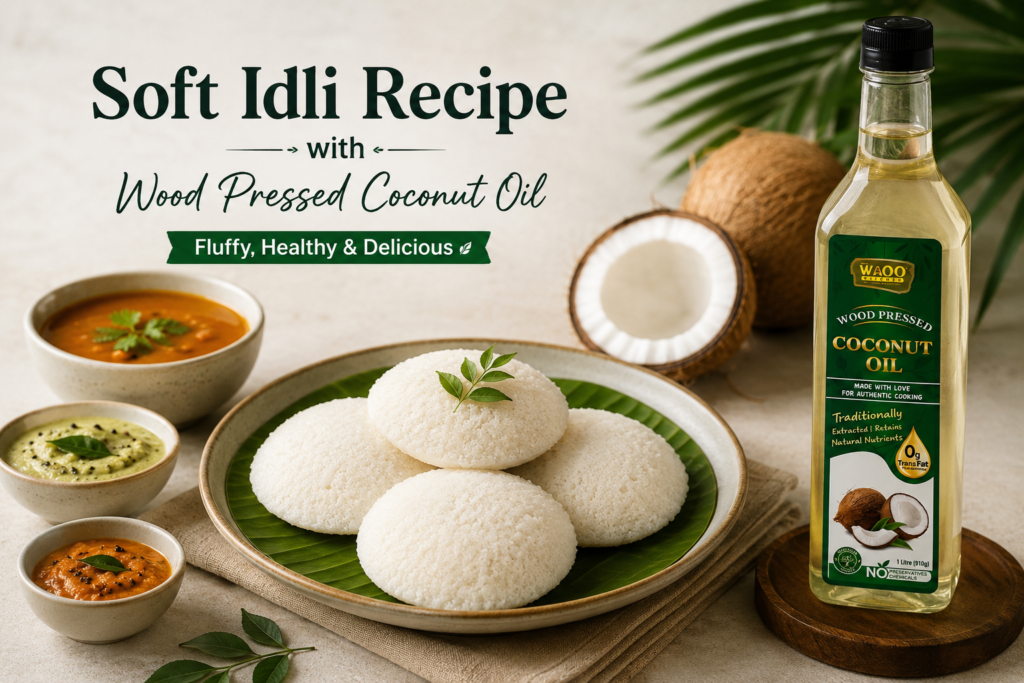
Why Wood Pressed Coconut Oil is Essential for Idli
While idli itself contains no oil — pure wood pressed coconut oil plays a crucial role in two ways:
1. Greasing the Idli Moulds:
The most important use — greasing idli plates with pure wood pressed coconut oil before pouring batter:
- Creates a natural non-stick surface
- Idlis release cleanly without breaking
- Adds a subtle authentic coconut aroma to the idlis
- Makes the outer surface of idli slightly glossy and beautiful
2. Serving with Coconut Oil:
Many traditional South Indian families drizzle warm wood pressed coconut oil directly on hot idlis before serving — the oil soaks into the soft idli giving it a beautiful flavour and adding lauric acid nutrition.
Why not refined oil?
Refined coconut oil has been deodorised and stripped of its natural aroma. Our wood pressed coconut oil retains its natural sweet coconut fragrance — giving idlis that authentic South Indian character that is impossible to achieve with refined oil.
Ingredients
Makes: 20 to 25 idlis
Soaking time: 6 to 8 hours
Fermentation time: 8 to 12 hours
Preparation time: 10 minutes
Steaming time: 12 minutes per batch
For the Idli Batter:
- 2 cups idli rice (parboiled rice)
- 1 cup whole urad dal — with skin or without
- ½ cup poha (flattened rice) — for extra softness
- 1 tsp fenugreek seeds (methi) — for fermentation and colour
- Salt to taste
- Water as needed — cold water preferred
For Greasing Idli Moulds:
- Wood Pressed Coconut Oil — for greasing every mould
For Serving:
- Peanut Chutney with wood pressed groundnut oil tadka
- Coconut chutney with wood pressed coconut oil tadka
- Hot sambar
- Pure cow ghee — drizzled on hot idlis (optional but extraordinary!)
- Raw forest honey warm water — as morning digestive drink
Step by Step Idli Batter Recipe
Step 1 — Wash and Soak
Soak the rice separately:
- Measure 2 cups idli rice
- Add poha and fenugreek seeds to the rice
- Wash thoroughly — 3 to 4 times until water runs clear
- Soak in plenty of water for 6 to 8 hours or overnight
Soak the dal separately:
- Measure 1 cup whole urad dal
- Wash thoroughly until water runs clear
- Soak separately in plenty of water for 4 to 6 hours
Why soak separately?
Rice and dal need different grinding consistencies. Soaking separately allows you to control each grinding perfectly — resulting in a better fermented batter and softer idlis.
Step 2 — Grind the Dal First
The order of grinding matters enormously for soft idli:
- Drain soaked urad dal completely
- Add to wet grinder or powerful blender
- Add ice cold water — very little at a time — 1 tablespoon at a time
- Grind for 20 to 25 minutes in a wet grinder
- The dal batter should be:
- Extremely smooth — like whipped cream
- Very fluffy and airy — almost doubled in volume
- White and glossy
- Slightly sticky when you rub between fingers
The ice cold water secret:
Using ice cold water keeps the batter cool during grinding — preventing the motor heat from killing the natural bacteria needed for fermentation. This one trick dramatically improves fermentation and idli softness.
The fluffiness test:
Drop a small amount of dal batter in a glass of water. If it floats — the batter is perfectly ground and airy. If it sinks — grind more.
Remove to a large vessel — the batter will double during fermentation.
Step 3 — Grind the Rice
- Drain soaked rice with poha and fenugreek
- Add to grinder
- Add cold water gradually
- Grind to a slightly coarse consistency — slightly grainy
- Rice batter should be:
- Slightly coarse — not as smooth as dal
- Flowing consistency
- Light cream or white colour
Why rice should be slightly coarse?
The slightly coarse rice batter creates a better texture in the idli — slightly spongy with tiny air pockets. Completely smooth rice batter gives dense rubbery idlis.
Step 4 — Combine and Mix
- Add rice batter to the dal batter
- Add salt — 1.5 teaspoons for this quantity
- Mix well using your hand
- Traditional method uses hands — the natural warmth and bacteria on hands actually aids fermentation!
- Mix for 2 to 3 minutes until completely combined
- The combined batter should be:
- Thicker than dosa batter
- Pourable but not runny
- Slightly frothy on top
Step 5 — Fermentation (The Soul of Perfect Idli)
Perfect fermentation is what creates the soft spongy texture of authentic idli:
- Transfer batter to a large container — leave space for it to double
- Cover loosely — not airtight — batter needs to breathe
- Keep in a warm place for 8 to 12 hours
Best fermentation spots:
- Oven with just the light on — maintains 28 to 32°C
- Inside microwave with a cup of warm water
- Warm corner of your kitchen
- Instant Pot on yogurt setting for 8 hours
Signs of perfect fermentation:
- ✅ Batter has doubled or almost doubled
- ✅ Tiny bubbles visible throughout
- ✅ Pleasant sour smell — mild
- ✅ Batter looks light and airy
- ✅ Surface is slightly domed
Season wise tips:
- Summer — 6 to 8 hours sufficient
- Winter — 12 to 16 hours needed
- Rainy season — 8 to 10 hours
Step 6 — Prepare for Steaming
After fermentation:
- Gently stir the batter — do not over mix or you lose air bubbles
- Check consistency:
- For idli — slightly thick — thicker than dosa batter
- Should drop slowly from spoon — not pour rapidly
- Add water only if absolutely necessary — very little
- Taste and adjust salt
Step 7 — Grease Idli Moulds with Wood Pressed Coconut Oil
This is where our wood pressed coconut oil makes all the difference:
- Take your idli stand and plates
- Apply wood pressed coconut oil generously to every single mould
- Use your finger or a small brush
- Make sure every part of the mould is coated
- The coconut oil creates a perfect non-stick surface
- The natural coconut aroma will subtly perfume the idlis as they steam
Generous oiling is important:
Under-oiled moulds cause idlis to stick — they tear when removed and look ugly. Well-oiled moulds release perfect smooth idlis every time.
Step 8 — Fill and Steam
- Add water to the bottom of your idli pot — 2 cups approximately
- Heat on medium high flame until water boils
- Pour batter into each greased mould — fill only ¾ full
- The batter will expand during steaming — leave space
- Place the idli stand in the steamer
- Cover with a tight lid
- Steam on medium high flame for 10 to 12 minutes
How to know idlis are done:
- Insert a toothpick or knife — it should come out clean
- The surface looks set and slightly glossy
- A clean break between the idli and the mould edge
- Timer at 12 minutes — always reliable
Do not over steam:
Over steamed idlis become hard and rubbery. Exactly 10 to 12 minutes on medium high heat gives perfectly soft idlis every time.
Step 9 — Rest and Remove
- Turn off flame
- Wait 2 minutes before removing idlis — this is critical
- Open the lid carefully — steam will escape
- Let idlis rest 1 more minute
- Use a wet spoon to scoop out each idli
- Wet spoon prevents sticking even better than dry
The wet spoon trick:
Dip your spoon or spatula in water before scooping each idli. The water creates a thin layer between the spoon and idli — they slide out perfectly every time.
Step 10 — Serve
Traditional serving:
- Place 2 to 3 idlis on a plate or banana leaf
- Add peanut chutney on the side
- Add coconut chutney
- Pour hot sambar
- Optional — drizzle pure cow ghee or wood pressed coconut oil on hot idlis
The ghee drizzle upgrade:
A small drizzle of pure cow ghee on hot idlis is a classic South Indian tradition — especially for children and elderly. The ghee soaks into the soft idli making it richer, more nutritious and absolutely delicious.
Idli Varieties
Mini Idli (Button Idli)
Use mini idli moulds. Makes bite-sized idlis perfect for children and chaat. Serve dipped in sambar or tossed in wood pressed sesame oil with curry leaves and mustard seeds.
Thatte Idli (Plate Idli)
Karnataka specialty — large flat idlis made in special flat moulds. Much larger than regular idli. Served with peanut chutney and coconut chutney.
Kanchipuram Idli
Famous temple prasad idli from Kanchipuram Tamil Nadu. Same batter with added cumin, pepper, ginger and cashews. Cooked in traditional vessels.
Idli Upma
Day old leftover idlis crumbled and tossed in a spiced tadka. Use wood pressed groundnut oil for the tadka. Quick nutritious lunch or evening snack.
Masala Idli
Cut idlis into quarters. Toss in a spiced wood pressed groundnut oil tadka with onions, tomatoes, green chilli and spices. Quick and delicious variation.
Idli Chaat
Mini idlis topped with chutneys, sev, onions, pomegranate and chaat masala. Surprisingly delicious street food style variation.
Rava Idli (Instant Idli)
No fermentation needed — made with semolina (rava) and curd. Quick 30 minute version. Grease moulds with wood pressed coconut oil. Perfect for busy mornings.
Health Benefits of Idli with Wood Pressed Coconut Oil
Idli Benefits:
- Completely steamed — zero oil in cooking
- Naturally gluten free — safe for gluten intolerance
- Probiotic rich — fermentation creates beneficial bacteria
- High in protein from urad dal — 25 grams per 100 grams dal
- Very low in calories — 2 idlis approximately 60 to 70 calories
- Easy to digest — fermentation pre-digests complex carbohydrates
- Suitable for all ages — babies to elderly
Fermentation Benefits:
- Increases B vitamin content dramatically — especially B12
- Increases iron bioavailability — body absorbs more iron
- Creates natural probiotics — supports gut microbiome
- Reduces anti-nutrients — phytates and oxalates reduced
- Lowers glycemic index — slower blood sugar release
- Makes nutrients more bioavailable overall
Wood Pressed Coconut Oil Benefits:
- Lauric acid — natural antimicrobial and immune booster
- MCTs — instant energy burned not stored
- Natural antioxidants — fully preserved
- Supports thyroid function
- Anti-inflammatory properties
- Read more: Wood Pressed Oil vs Refined Oil
Why Idli is Ayurveda’s Ideal Breakfast:
Ayurveda considers idli to be one of the most sattvic and easily digestible foods available. It is:
- Light on digestion — does not burden Agni (digestive fire)
- Naturally fermented — aids digestive fire
- Neutral in nature — balances all three doshas
- Suitable for daily consumption — can be eaten every morning without any issue
- Enhanced by pure ghee or coconut oil — makes it more complete
Idli for Special Diets
For Weight Loss:
- Idli is one of the best weight loss breakfast foods
- Very low calorie — 2 idlis with chutney approximately 150 calories
- High protein from dal — keeps you full longer
- The fermentation creates resistant starch — feeds good gut bacteria
- Skip the ghee drizzle — save calories
For Diabetics:
- Fermented idli has lower glycemic index than plain rice
- High protein from dal slows glucose absorption
- Small portion with sambar and chutney — balanced meal
- Skip or reduce accompaniments with sugar
For Babies (8 months onwards):
- Idli is India’s most popular first solid food for babies
- Very soft and easy to swallow
- Mash with pure cow ghee for extra nutrition
- Add warm water to make softer for younger babies
- Do not add salt for babies under 1 year
For Elderly:
- Extremely easy to digest
- Soft texture — no chewing difficulty
- High nutrition despite easy digestibility
- Served with sambar provides complete nutrition
Pro Tips for Perfect Soft Idli Every Time
Tip 1 — Idli Rice is Non-Negotiable
Always use idli rice (parboiled rice) — not regular raw rice or basmati. Idli rice has the right starch content for soft spongy idlis. Regular rice gives hard dense idlis.
Tip 2 — Grind Dal Until Extremely Fluffy
The dal must be ground to an extremely smooth fluffy batter — almost like whipped cream. This takes 20 to 25 minutes in a wet grinder. The fluffiness of dal batter directly determines the softness of idlis.
Tip 3 — Use Ice Cold Water for Grinding
Always use ice cold water during grinding. This keeps batter temperature low — preserving the natural bacteria that make fermentation work. Room temperature or warm water reduces fermentation effectiveness.
Tip 4 — Add Poha for Extra Softness
Adding ¼ to ½ cup of poha (flattened rice) to the rice while soaking makes idlis significantly softer and helps with fermentation. This is the most effective single ingredient upgrade.
Tip 5 — Ferment Until Doubled
Never rush fermentation. Properly fermented batter that has doubled in size gives light spongy idlis. Under-fermented batter gives flat dense idlis. Wait until the batter has clearly risen.
Tip 6 — Grease Moulds Generously with Coconut Oil
Under-greased moulds are the number one cause of idlis sticking and tearing. Use generous wood pressed coconut oil on every mould before every batch.
Tip 7 — Fill Only 3/4 Full
Idli batter expands significantly during steaming. Overfilling causes idlis to overflow and stick together. Fill each mould only 3/4 full — always.
Tip 8 — Steam Exactly 10 to 12 Minutes
Under steaming — idlis are wet inside. Over steaming — idlis become hard. Exactly 10 to 12 minutes on medium high heat gives perfect results every time. Use a timer.
Tip 9 — Rest Before Removing
Wait 2 minutes after turning off heat before removing idlis. This resting time allows the idli to set completely and release more easily from the mould.
Tip 10 — Use Wet Spoon
Always use a wet spoon or spatula to remove idlis. The thin layer of water prevents any sticking — even from slightly under-oiled moulds.
Troubleshooting Common Idli Problems
| Problem | Cause | Fix |
|---|---|---|
| Idli is hard | Over steamed or under fermented | Steam exactly 12 min — ferment fully |
| Idli is flat | Under fermented batter | Ferment longer — batter must double |
| Idli is sticky | Under-greased moulds | Apply generous coconut oil to all moulds |
| Idli is yellow | Too much fenugreek | Reduce fenugreek to ½ tsp |
| Idli has no holes | Dal not fluffy enough | Grind dal longer — add less water |
| Idli tastes sour | Over fermented | Reduce fermentation time — use in refrigerator |
| Batter not fermenting | Too cold | Find warmer spot — use oven with light on |
| Idli tears when removed | Under-oiled or removed too hot | Oil generously — rest 2 min after steaming |
The Perfect South Indian Breakfast Using Waookytchen Products
Create the complete authentic South Indian breakfast experience:
| Item | Waookytchen Product |
|---|---|
| Soft Idli | Wood Pressed Coconut Oil for greasing |
| Ghee drizzle on idli | Pure Cow Ghee |
| Peanut Chutney | Wood Pressed Groundnut Oil — read: Peanut Chutney Recipe |
| Crispy Dosa | Wood Pressed Coconut Oil — read: Crispy Dosa Recipe |
| Morning drink | Honey Lemon Water with Raw Forest Honey |
Every element of this breakfast made with pure natural ingredients from Waookytchen! 🎉
Frequently Asked Questions
Q: What is the difference between idli rice and regular rice?
Idli rice is parboiled (partially boiled before milling) which gives it a different starch structure. This starch creates the soft spongy texture characteristic of good idli. Regular raw rice gives harder denser idlis. Idli rice is available at all South Indian grocery stores.
Q: Can I make idli batter in a regular mixer instead of wet grinder?
Yes — but a wet grinder gives significantly better results. In a mixer grind dal in short pulses with cold water adding very gradually. The batter will not be as fluffy as wet grinder batter but still works. If using mixer — grind dal for at least 10 minutes.
Q: How long does idli batter last?
Refrigerated idli batter lasts 5 to 7 days. The batter becomes more sour as it ages. Slightly sour batter actually gives more flavourful idlis — many people prefer 2 day old batter. Always bring batter to room temperature before making idlis.
Q: Can I use the same batter for dosa?
Yes — idli batter makes excellent dosa too. For dosa thin the batter slightly with water. Use wood pressed coconut oil on the tawa. Read our complete guide: Crispy Dosa Recipe
Q: Why do my idlis smell too sour?
The batter is over fermented. In summer ferment for only 6 to 8 hours. If batter becomes too sour — add a small amount of fresh batter or refrigerate immediately to stop further fermentation.
Q: Can I steam idlis without an idli stand?
Yes — pour batter into small steel bowls or katoris greased with wood pressed coconut oil. Place on a stand inside a large pot of boiling water. Cover and steam for 12 minutes. Works perfectly well.
Q: Is idli good for weight loss?
Absolutely — idli is one of the best weight loss breakfast options. 2 idlis with sambar and chutney provide protein, fibre and probiotics for approximately 200 calories total. The fermentation creates resistant starch that feeds good gut bacteria and supports metabolism.
Buy Wood Pressed Coconut Oil from Waookytchen
The authentic flavour and perfect release of your idlis depends on the quality of coconut oil you use for greasing. At Waookytchen our wood pressed coconut oil is:
- ✅ Cold pressed using traditional wooden method
- ✅ Natural sweet coconut aroma — authentic South Indian flavour
- ✅ Rich in lauric acid and MCTs
- ✅ Zero chemicals or solvents
- ✅ Perfect for greasing idli moulds
- ✅ Lab tested every batch for purity
- ✅ Free delivery above ₹499 across India
- ✅ Cash on delivery available
Order Wood Pressed Coconut Oil from Waookytchen →
Final Thoughts
Perfectly soft idli is not difficult — it just needs the right ingredients, the right technique and the right oil. With our complete step by step guide and pure wood pressed coconut oil from Waookytchen — you can make restaurant quality soft idlis at home every single morning.
Soak the rice and dal tonight. Wake up to perfectly fermented batter tomorrow. Grease your moulds with pure coconut oil. Steam for 12 minutes. And enjoy the most perfect, most nutritious, most satisfying South Indian breakfast that exists.
Leave a Reply